Facebook Groups vs Paid Ads: What Wins?
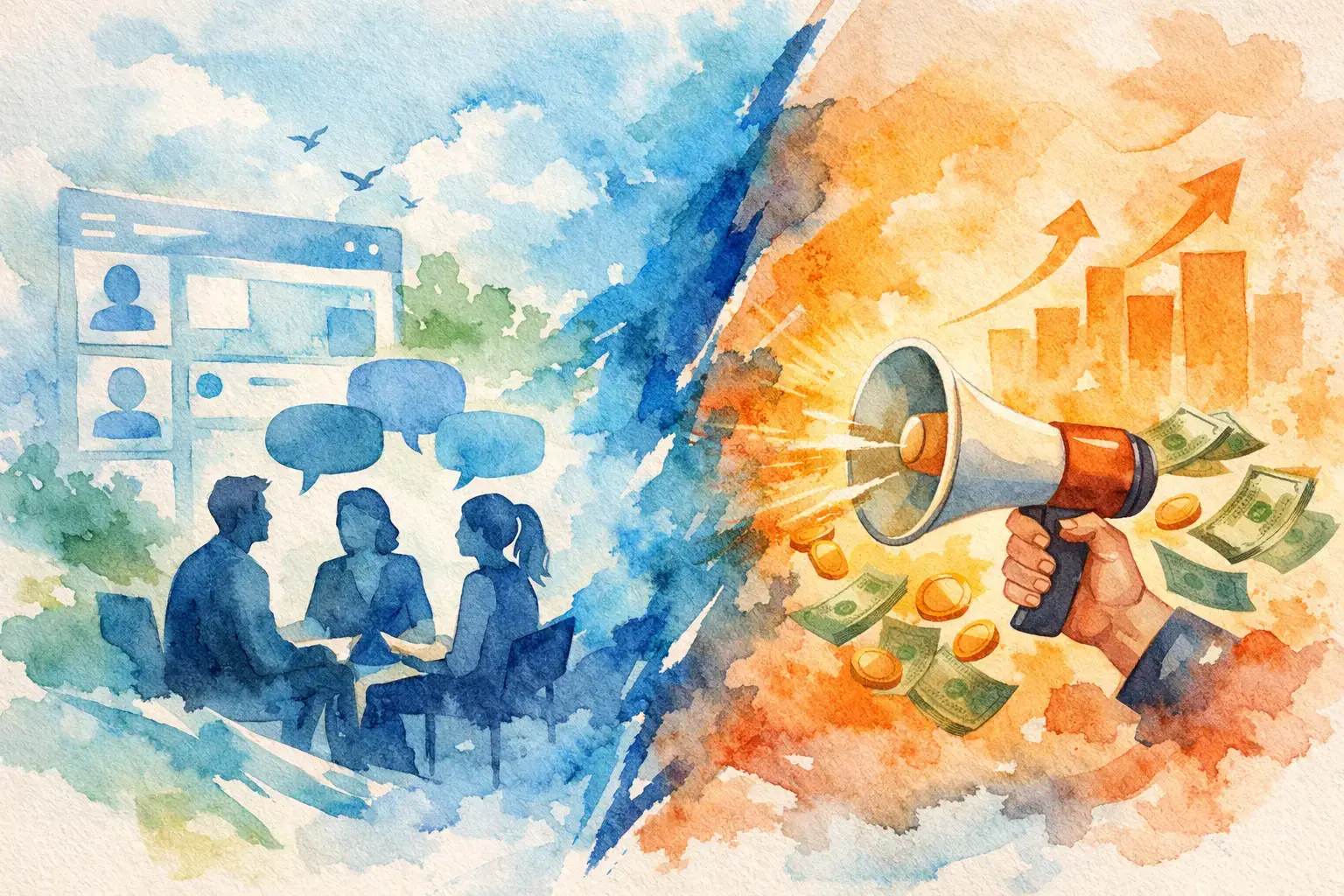
A lot of marketers learn this lesson the expensive way: you can spend $100 a day on ads and still get colder leads than one strong post in the right Facebook Group. That is the real tension inside facebook groups vs paid ads. One channel buys attention. The other earns it. If your business depends on lead flow, speed matters – but so does trust.
The wrong comparison is asking which one is better in the abstract. The right question is which one gives you lower acquisition cost, stronger conversations, and a system you can actually scale without burning time or budget.
Facebook Groups vs Paid Ads: The real difference
Paid ads are rented reach. You set targeting, launch creative, and pay for every impression, click, or result. That gives you speed and control. It also means the moment you stop spending, the traffic slows down.
Facebook Groups work differently. They are trust environments. People join around location, identity, profession, problem, or interest. When you post inside the right group, you are not interrupting someone mid-scroll with a sponsored pitch. You are entering an existing conversation. That difference changes lead quality.
For coaches, real estate agents, local services, recruiters, affiliates, and B2B operators, trust usually beats raw reach. A group post that sounds native to the community can pull comments, DMs, and referrals in a way paid ads often struggle to match.
That does not mean groups replace ads in every case. It means they solve a different part of the funnel, and for many businesses they solve it more profitably.
Where paid ads still win
Paid ads are built for immediate distribution. If you need traffic this afternoon, ads can deliver it. They also give you strong testing conditions. You can split audiences, angles, offers, and creatives faster than most organic channels.
They are also cleaner when you need strict reporting. Cost per click, cost per lead, and conversion metrics are easier to track in ad platforms than in community-driven outreach. For businesses with proven funnels, high-ticket economics, and enough margin to absorb testing costs, ads can scale hard.
But the trade-off is brutal if the offer is weak or trust is low. CPMs rise. Click quality slips. Lead forms fill with low-intent names. Creative fatigue sets in. Then your so-called scalable channel turns into a cash drain.
Paid ads work best when three things are already true: your message is dialed in, your conversion path is solid, and your economics can handle volatility.
Where Facebook Groups win harder than most marketers expect
Groups outperform when the sale depends on context, credibility, and conversation. That includes local services, referral-based offers, recruiting, consulting, and any business where buyers want to feel out the person behind the pitch.
Inside groups, the best posts often do not look like ads. They look like useful observations, local recommendations, case-based stories, or direct offers framed for the group. That lowers resistance and increases response quality.
There is also a cost advantage. Organic group marketing does not charge you for every impression. Your cost is time, consistency, and execution. If you can systemize those three, the economics get very attractive.
This is why the facebook groups vs paid ads decision often comes down to more than budget. It comes down to whether your business needs attention at scale or trust at scale. For many small and mid-size operators, trust is the bottleneck.
Cost is not just spend – it is waste
Marketers love talking about ad spend, but they ignore waste. Waste is the budget spent on weak traffic, weak leads, and weak intent. Waste is also time spent manually posting in 80 groups, rewriting the same message, tracking replies in scattered tabs, and trying not to trigger platform restrictions.
Paid ads create financial waste when targeting or creative misses. Facebook Groups create operational waste when outreach stays manual.
That is where smart operators separate from hobby marketers. The real move is not choosing one channel with religious loyalty. The real move is reducing waste in whichever channel you use.
If you are running groups manually, your ceiling is low. Posting one by one, juggling schedules, and trying to vary copy across dozens of communities does not scale. The opportunity is strong, but the execution model breaks first.
Scale changes the argument
At small volume, Facebook Groups can feel easy. Join a few communities, make a few posts, respond to comments, get some leads. At larger volume, it becomes a systems problem.
You need organized group collections, campaign scheduling, post variation, pacing controls, reply monitoring, and a way to spot conversations where buyers are already raising their hands. Without that infrastructure, group marketing turns into repetitive labor.
That is why serious marketers should not compare ads to manual group posting. They should compare ads to engineered group outreach. Those are two very different things.
Once group campaigns are organized and automated intelligently, the channel starts looking a lot stronger. You keep the trust advantage of organic visibility while removing the time cost that usually makes it hard to scale.
Speed vs compounding
Paid ads are faster at launch. Facebook Groups are stronger at compounding.
An ad can produce traffic within hours, but every result depends on continued spend. Group activity compounds because each strong post can generate comments, profile views, direct messages, repeat visibility, and credibility inside the community. Even when a post stops getting fresh engagement, the market memory often sticks.
If you are building a brand or personal authority, groups have another edge. Prospects see you in discussion threads, recommendations, and recurring posts. You become familiar. That makes follow-up warmer and close rates better.
For a local business owner, agency, recruiter, or consultant, that familiarity is not a soft metric. It affects revenue.
Risk matters on both sides
Ads have obvious risk: budget burn. You can spend quickly and learn slowly if your funnel is weak.
Groups carry a different kind of risk: poor execution can trigger friction with admins, low-quality responses, or account issues if you blast repetitive content carelessly. That is why the method matters as much as the channel.
Safe scaling inside Facebook Groups requires human-like pacing, content variation, campaign control, and a workflow that respects how the platform actually behaves. Sloppy automation is not a growth strategy. It is a shortcut to disruption.
The upside is that modern tooling can reduce that risk when it is built specifically for Facebook Group workflows instead of generic social scheduling. That means local execution, adaptive behavior, and features designed around group posting realities rather than broad social media theater.
So which one should you choose?
If you need immediate traffic, have budget to test, and already know your funnel converts, paid ads deserve a place in the mix. They are still the fastest way to force distribution.
If your offer sells best through trust, conversation, community presence, or local relevance, Facebook Groups are often the stronger acquisition engine. And if your current hesitation is time, that is not really a channel problem. It is an execution problem.
For many businesses, the best path is simple. Use paid ads for fast testing and predictable volume. Use Facebook Groups for lower-cost lead flow, warmer conversations, and long-term authority. But if you can only invest deeply in one channel right now, pick the one that matches how your buyers actually make decisions.
If they convert because they saw your brand three times in a feed and clicked a form, run ads. If they convert because they trust the person behind the post, groups will usually beat ads on lead quality.
That is why aggressive operators are putting more attention on scalable group outreach. Not because ads are dead. Because relying on paid traffic alone is expensive, fragile, and often weaker at building trust. Tools like Group Posting PRO make that shift practical by turning group marketing from manual grind into a repeatable lead engine.
The smartest marketers are not asking whether organic or paid is more popular. They are asking which channel gives them more control over outcomes. When trust is the lever, Facebook Groups are hard to beat.
Want this handled automatically? See everything Group Posting can do, or compare plans on Group Posting pricing.