Facebook Ads Budget 2026: Plan Spend from Your Goals
- Facebook ads
- Marketing budgets
- Lead generation
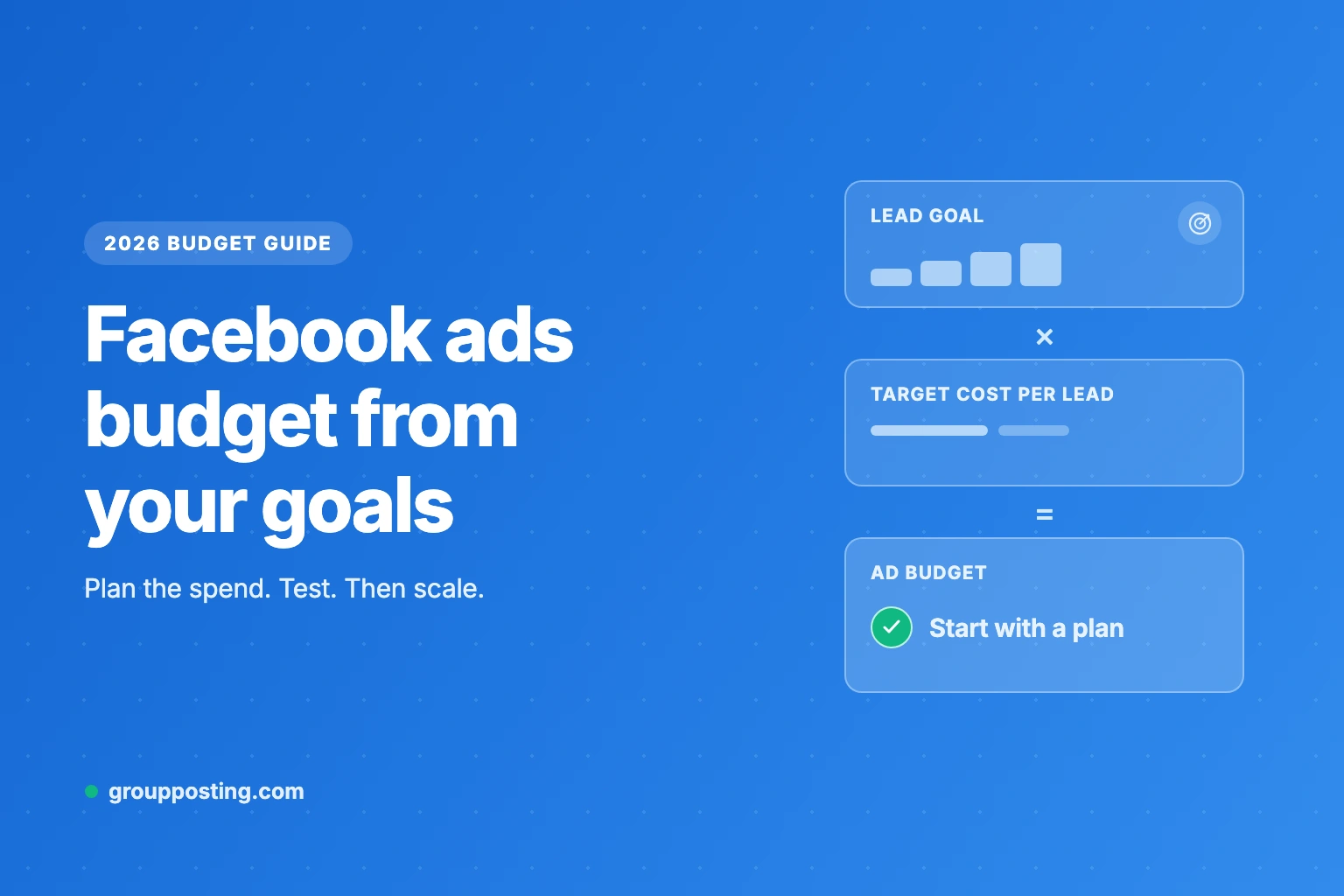
Build your Facebook ads budget from the customers you need and the cost you can afford to acquire them. Divide your customer goal by your lead-to-customer rate, then multiply the resulting lead goal by your target cost per lead. Put a cash limit and a review date around the first test before committing to a monthly spend.
For example, eight new customers at a 25% close rate require 32 leads. At an assumed $25 per lead, that is $800 in ad spend, or about $27 a day over 30 days. Those are planning assumptions, not a forecast. Your creative, follow-up and local market still have to make the numbers work.
This guide is for small businesses planning enquiries, appointments or quotes. All worked examples use US dollars; keep your own worksheet in one currency. Media spend is separate from tax, creative, management fees, software and staff time.
1. Work backwards from a customer goal
A round monthly allowance is a constraint, not a strategy. Start with the work you can actually deliver: available cleaning slots, memberships you can support or consulting projects you can onboard.
- Set a customer goal. Use additional paying customers, not clicks or form submissions.
- Estimate your close rate. Divide customers won by comparable leads received. Use a consistent lead definition and allow enough time for those leads to buy. If you have no history, label the rate as an assumption and test a worse case too.
- Set an affordable acquisition cost. Start from what a customer contributes after delivery costs. Leave room for overhead, profit and other acquisition costs. Do not treat total revenue or hoped-for lifetime value as money available today.
- Calculate a target CPL. Multiply your media-only acquisition allowance by the close rate. This is the cost you need to achieve, not evidence that the auction will deliver it.
- Calculate the campaign budget. Customer goal ÷ close rate = required leads. Required leads × target CPL = planned media spend.
In the cleaning example, suppose a new customer contributes $250 after service delivery costs over the period you can fund. Reserving $150 for overhead, profit and other acquisition work leaves $100 for ads per acquired customer. A 25% close rate makes the target CPL $25: $100 × 0.25.
Check the downside before launching. If the close rate falls to 12.5%, the same 32 leads produce four customers, making media acquisition cost $200. Reaching eight customers would require 64 leads and $1,600 at the same CPL. If you cannot fund that outcome, lower the initial goal or improve the offer and follow-up before increasing spend.
Track the journey beyond the form with UTM parameters and a lead log. Record source, enquiry date, qualification, booking and payment. Count each customer once when they encounter both an ad and an organic post.
2. Use 2026 Facebook ad costs as a sense check
WordStream/LocaliQ’s 2026 Facebook Ads Benchmarks, published 14 September 2026 and checked 18 October 2026, reports the following USD medians. Its sample covers 1,377 US traffic campaigns and 452 US leads campaigns running from 1 April 2025 to 30 June 2026.
| Objective | Metric | USD |
|---|---|---|
| Traffic | Cost per click | $0.60 |
| Leads | Cost per click | $1.80 |
| Leads | Cost per lead | $27.39 |
These are US campaign medians, not quotes for your town. The leads sample allows subcategories with as few as four campaigns. A reported lead is not necessarily qualified or sold. Compare like objectives and lead definitions; replace benchmarks with your own mature results when available.
Do not multiply traffic-campaign clicks by the conversion rate of a different lead-campaign sample. Those audiences and objectives differ. Nor should a low CPC persuade you to switch to traffic if your real goal is appointments. Cheap visits can still produce expensive customers.
For broader context, Meta’s Q2 2026 results, released 29 July 2026, report that average price per ad rose 12% year on year. That is an aggregate price measure, not Facebook CPM, CPC or your expected CPL. It does not justify automatically adding 12% to your next budget.
3. Separate a test budget from a monthly commitment
For a new offer, buy a bounded experiment. Write down the audience, offer, conversion event, target CPL, sales follow-up owner and maximum amount you can lose. Start with a simple structure rather than dividing limited money between many similar ad sets.
Illustrative test: reserve $300 for a 14-day first run. At an assumed $25 CPL, that funds about 12 leads, averaging roughly $21 a day. Twelve leads can expose an irrelevant audience or broken booking process; they cannot establish a dependable long-term close rate. Extend only if the initial evidence and your cash position justify it.
The 14 days are a suggested review window for this example, not a Meta requirement or a guarantee of statistical significance. A business with a longer sales cycle must allow more time for customer outcomes. Check delivery and tracking during the test; a broken form or exhausted cash limit is a reason to stop early.
In this example, the $600 monthly envelope is a spending ceiling: $300 initial test, $180 held for a justified follow-up test and $120 left uncommitted. These are suggested allocations, not industry benchmarks. There is no obligation to spend the reserve. Keep production and response-handling costs outside this media-only envelope.
Before paying for delivery, submit a test enquiry through your own form, verify that it arrives, check the booking page on a phone and confirm how sales are recorded. Use the measurement and consent setup appropriate to your business. Avoid choosing success metrics only after seeing which numbers look attractive.
4. Treat minimum budgets and learning as separate checks
Meta’s minimum-budget guidance, checked 18 October 2026, makes requirements dependent on settings including bid strategy, optimisation, currency and schedule. Ads Manager alerts you when a budget is too low. Its public pricing page, checked the same day, suggests at least a $5 budget over more than six days; that wording does not establish a universal $5 daily minimum.
Meta’s learning-phase guidance, checked 18 October 2026, says an ad set usually stabilises after about 50 results in the week following its last significant edit. This is a delivery guideline, not a profitability requirement or a promise that learning ends on a particular day.
For scale, 50 leads at an assumed $25 CPL would mean $1,250 per week, about $179 a day. That arithmetic describes the volume in the guideline; it is not a compulsory minimum for a small-business test. Do not spend beyond your loss limit simply to pursue a delivery-status label.
Keep the optimisation event aligned with what you want people to do. Moving from leads to clicks changes the job you ask Meta to perform; it does not make those clicks equivalent to leads. A lower-volume lead test can still inform a business decision, but expect more uncertainty and avoid promising a fixed number of customers.
Also distinguish an average daily budget from a strict daily cash ceiling. Review the spending terms shown in your account and consider the available lifetime-budget and spending-limit controls for a fixed experiment. Check campaign dates, other active campaigns and any separately billed fees before publishing.
5. Three worked budgets for small businesses
Every figure in these examples is hypothetical. The close rates and target CPLs illustrate the method; they are not industry performance claims. Each monthly daily average assumes 30 days, and each customer goal must fit the business’s delivery capacity.
A cleaning business filling eight customer slots
Assume a 25% lead-to-customer rate and a $25 target CPL. Eight customers need 32 leads, implying $800 in monthly media spend, about $27 a day. Media acquisition cost would be $100 per customer.
Define a lead as a valid enquiry within the service area, then record how many become paid jobs. If bookings are weak, check location, availability, quote clarity and follow-up before buying more enquiries. For the community side of the same business, use our cleaning-business client acquisition guide.
A fitness studio seeking twelve memberships
Assume 30% of enquiries become members and target $20 per enquiry. Twelve memberships require 40 leads and an $800 monthly media budget, about $27 a day. That implies roughly $67 in ad spend per member.
Track enquiry, attended trial and paid membership separately. If leads arrive but trial attendance is poor, the booking and reminder process deserves attention. Keep the $20 target tied to your economics; a benchmark cannot make an unprofitable membership offer viable.
A consultant seeking three projects
Assume a 10% lead-to-client rate and a $60 target CPL. Three clients require 30 leads and $1,800 in media spend, or $60 a day. Media acquisition cost would be $600 per client, before proposal-writing and sales time.
Allow for the gap between enquiry and a signed contract. Review qualification while deals mature, but do not count every booked call as a customer. If you only have capacity for one project, reduce the goal instead of generating enquiries you cannot serve.
These example costs per lead are round planning inputs, not benchmarks. Some sit below the WordStream medians above (for example, $27.11 for health and fitness), so run the same sums with a worse cost per lead before you commit to a monthly budget.
6. Scale only after the customer economics hold
At the review date, reconcile ad spend with your lead log and actual sales. Compare qualified CPL and customer acquisition cost across cohorts that have had enough time to convert. A strong day or an unusually large sale should not determine the next month’s commitment.
- Stop and repair: tracking fails, enquiries are irrelevant, customers cost more than your allowance, or the cash limit is reached.
- Hold: useful enquiries are arriving, but the sales cycle is unfinished or the sample is too small to judge.
- Increase cautiously: mature customer outcomes meet your cost limit, cash is available and the team can handle more work.
A modest step makes the next commitment easier to control. For example, increasing an established $30 daily budget to $33 is a 10% change. That is an illustrative operating choice, not a Meta-approved threshold that guarantees learning will remain unchanged. Choose the next review after enough additional enquiries and sales can mature, and document the effect before another increase.
Common mistakes that waste the first budget
- Calling revenue profit. Include delivery, refunds, sales time and other acquisition costs before deciding what a customer can cost.
- Mixing objectives or currencies. A traffic CPC, lead CPL and purchase acquisition cost answer different questions.
- Splitting a small test too widely. Several underfunded comparisons can leave you with little useful evidence in any one.
- Changing everything together. A new offer, audience and landing page make the cause of a result hard to interpret.
- Spending the reserve automatically. A calendar date is not evidence that a weak campaign deserves more money.
7. Stretch the budget with useful Facebook group participation
Organic group posting can support a local service or niche business when relevant communities permit useful commercial contributions. A practical answer, transparent business introduction or allowed offer can start a conversation without an auction media charge. Research, writing, moderation and replies still cost time, and publication does not guarantee reach or leads.
Ads are the stronger fit when you need paid distribution beyond communities you can legitimately participate in, control over campaign delivery or a defined conversion test. Groups depend on rules, administrators, relevance and your willingness to contribute. Our Facebook groups versus paid ads comparison explores that choice; this budget method does not assume one replaces the other.
Allocate a separate group-work time budget and measure it alongside ad spend. Use the group marketing cost worksheet to include software and labour, and the ROI calculator to explore your own time-saving assumptions. Neither is evidence that group posting will deliver a particular customer acquisition cost.
Group Posting Pro helps organise the publishing work. The auto poster and scheduler includes simple schedules on Plus and Pro; the Pro campaign builder organises sequences. Review content, destinations and timing, then start the run. Posts go one group at a time from your own browser; keep Chrome open, the computer awake and online, Facebook signed in and the extension enabled.
For an example of appropriate community work, see group posting for local businesses. Skip promotional posts where rules prohibit them and confirm uncertain permissions first. Group rules and Facebook restrictions still apply; no tool can promise an account will never be restricted.
Frequently asked questions
How much should a small business spend on Facebook ads?
Start with required leads multiplied by an affordable target cost per lead, then cap the first test at an amount the business can lose. For example, 20 leads at an assumed $25 each imply $500 in media spend. Treat that as a planning calculation, not a promise of results.
Is $10 a day enough for Facebook ads?
It can fund a limited test if your account accepts the setup, but the outcome depends on the cost of the result you need. Over 30 days, $10 a day is $300. At an assumed $25 per lead, that would buy about 12 leads, with substantial uncertainty about how many become customers.
What is the minimum daily budget for Facebook ads?
Check the minimum and spending terms shown in your current Ads Manager setup. A budget accepted by the platform is not proof that it will produce enough qualified leads or sales for your business. Set a test limit from your cash position and customer economics.
When should I increase my Facebook ad budget?
Increase only when tracking works, leads have had time to become customers, acquisition cost fits your allowance and you can serve more demand. Make a controlled change and review the next mature results. No fixed percentage guarantees that performance or learning status will stay unchanged.
Can organic Facebook group posts replace paid ads?
For some businesses, permitted group participation can generate useful conversations with little media outlay. It still takes time and offers no guaranteed reach. Keep ads when paid distribution supports your goals, and compare both channels using actual costs and customer outcomes.
Explore the complete guide: Facebook group marketing.
For the group-publishing part of your workflow, explore the group auto-poster and scheduler, or compare plans on Group Posting pricing.