First 10 Customers from Local Facebook Groups: A 30-Day Work Plan
- Facebook groups
- First customers
- Marketing planning

To work towards your first 10 customers from local Facebook groups, choose a service you can deliver, contribute where it is permitted and track suitable enquiries through to actual purchases. Use a 30-day activity budget to control your time, then compare the results with your capacity and offer. Ten customers is the goal in this plan, not a promised outcome or a deadline you should pursue by increasing unsolicited contact.
This guide provides illustrative group, post, reply and conversation numbers, hypothetical conversion maths and a practical review routine. Sources were checked on 31 October 2026.
What the data says about trust before the first purchase
A new business needs people to understand and check its offer before deciding. The following evidence supports preparation and transparent recommendations, rather than a target response rate.
- Reviews are widely read: BrightLocal’s February 2026 Local Consumer Review Survey found that 97% read reviews of local businesses. Its representative panel covered 1,002 US adults. This is review-reading behaviour, not evidence that every new business needs a particular number of reviews.
- People cross-check information: BrightLocal’s April 2025 search research, based on a panel of 1,000 US adults, found 56% often or always checked that business information matched other online mentions. Keep your service area and contact details consistent.
- Known people are a trusted source: Nielsen’s November 2021 analysis reports that 88% trusted recommendations from people they knew above other channels. Its September 2021 online survey covered more than 40,000 consumers across five global regions. Trust is different from a completed referral or purchase.
- Small firms are a substantial business population: the UK government’s October 2025 release estimated 5.64 million private-sector businesses with zero to 49 employees at the start of 2025. This separate UK context includes businesses without employees.
None of these figures supplies the conversion assumptions in the plan below. Keep those assumptions hypothetical and replace them with your own consistently defined enquiry and purchase records as evidence accumulates.
1. Define the target and the customer
Write one clear offer before counting activity: the service, actual area, scope and next step. A new local business needs work it can fulfil, not an inbox full of requests outside its capability. Confirm your available delivery time and a realistic route to an initial conversation.
Define a customer as a distinct person or business that completed your stated purchase or booking-confirmation requirements. Choose the definition that fits your operation and keep it consistent. A comment, quote request or provisional date is not automatically a customer.
Define a suitable enquiry separately: someone has voluntarily asked about work that appears to fit your service and area. A conversation explores that need through an agreed route. Repeated replies from the same person remain one relationship, rather than becoming several leads in the report.
The first-ten target can extend beyond the first month. A customer may need time to choose a date or compare scope, and your business may have limited delivery capacity. Do not accept unsuitable work merely to reach a round number.
2. Set a 30-day activity budget
The numbers below are an illustrative workload for a small business. They are not Facebook limits, universal recommendations or observed conversion figures. Use fewer activities when group rules, relevant questions or your capacity do not support them.
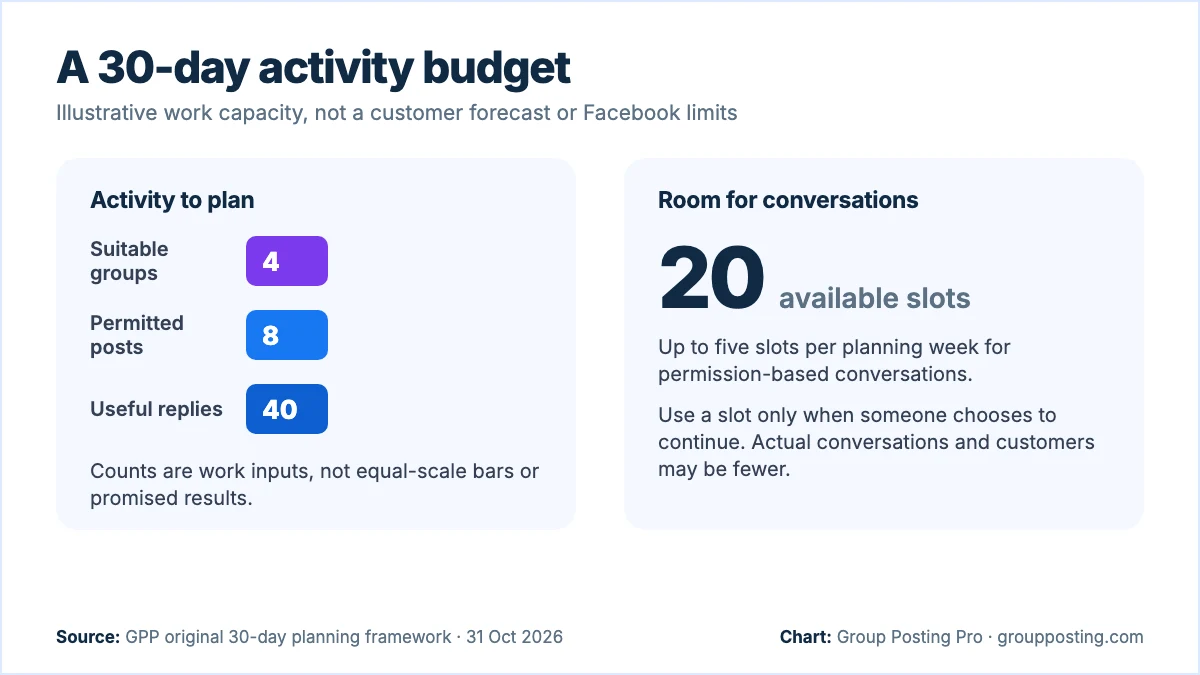
Start with four suitable groups you have already joined. Check their audience, location and permitted business activity. Plan up to eight permitted posts and up to 40 useful replies during the month. Reserve capacity for 20 permission-based conversations, rather than setting a target to initiate 20 private messages.
| Period | Posts, maximum planned | Useful replies, maximum planned | Conversation capacity | Main work |
|---|---|---|---|---|
| Days 1–7 | 2 | 5 | 5 slots | Check fit, rules and the offer |
| Days 8–14 | 2 | 10 | 5 slots | Answer real needs and clarify scope |
| Days 15–21 | 2 | 15 | 5 slots | Use questions to improve the explanation |
| Days 22–30 | 2 | 10 | 5 slots | Complete agreed next steps and review |
| Total | 8 | 40 | 20 slots | Capacity across 4 suitable groups |
A reply belongs only where you can add something useful and business participation is permitted. If the week contains three appropriate questions, answer those three. Do not manufacture discussion, repeat resolved answers or treat the remaining reply allowance as work that must be spent.
Likewise, conversation capacity is time you can make available when someone wants to continue. A public answer can complete the interaction without a private message. Leave unused capacity unused when there is no appropriate request.
3. Check the goal with hypothetical maths
Separate the customer target from the activity budget. The planning equation is: target customers divided by your assumed conversation-to-customer fraction equals the conversations needed. Before you have measured results, the fraction is only an assumption to test.
Hypothetical example, not a benchmark: if one in five suitable conversations became a customer, 10 customers would require 50 conversations. If one in 10 did, the requirement would be 100. Neither assumption is an observed Facebook group conversion rate.
The month’s 20 available conversation slots do not support an expectation of 50 or 100 completed conversations. At a capacity of five per week, those hypothetical workloads would need at least 10 or 20 weeks respectively, assuming enough suitable requests occurred. They could take longer or never produce the target.
Use one conversation cohort when calculating an observed fraction: the distinct people who completed your defined conversation stage during the period. Record which became customers and which decisions remain open. Do not divide this month’s purchases by an unrelated set of new enquiries, or count repeat messages as new people. Keep the source and date range alongside the calculation so you can compare like with like later.
Replace assumptions with your own records when you have them, using the same definitions and a suitable decision period. A small sample can change sharply after one outcome. Keep open enquiries visible instead of treating them as purchases or immediate failures.
4. Follow the monthly work plan
This numbered plan organises the work behind the table. Its stages are decisions and deliverables, rather than a sequence that every reader must complete at the same speed. Reduce activity when service delivery or enquiry handling needs the time.
- Days 1–3: prepare the offer. Write the service, area, inclusions, exclusions and contact route. Prepare a useful checklist or explanation that stands alone. Check how an actual customer confirms a purchase or appointment.
- Days 4–7: inspect the four groups. Record the URL, audience, permitted identity, promotion format and last rule-check date. Use only allowed destinations. Prepare up to two relevant posts and answer up to five genuine questions across the week.
- Days 8–14: improve first contact. Use the next permitted posting opportunities and up to 10 suitable replies. Answer the question before mentioning your service. Offer a further conversation only when the person wants it and the group permits the route.
- Days 15–21: clarify the recurring question. Use up to two posts and 15 replies where justified. Revise the offer if people misunderstand scope or area. Reserve delivery time for any work actually accepted.
- Days 22–27: complete agreed actions. Send requested information, check actual availability and follow up only in the agreed context. The final period’s budget remains up to two posts and 10 useful replies, not an obligation to fill unused allowances.
- Days 28–30: review distinct outcomes. Count confirmed visible posts, suitable enquiries, completed conversations and actual customers. Compare work time, fit and uncompleted decisions. Choose one change for the next period.
Keep a short private log with date, group, thread link, stated need, agreed next step and status. Avoid copying personal information that is not needed. Meta’s Pages, Groups and Events Policies require notice and explicit consent when collecting information from people interacting with a Page, group or event, and clarity about who collects it.
5. Use three conversation templates
These illustrative templates are starting points, not evidence of results. Replace every bracket with a checked fact. Do not add a customer story, qualification or availability claim that you cannot substantiate.
A useful public answer
Illustrative template: “For [stated task], start by checking [specific criterion]. It matters because [accurate reason]. I provide [service] in [area], so this is my business perspective. You can use that check with any provider. [Optional relevant question, if needed].”
Use it where provider advice is permitted. Answer the actual question without turning a simple explanation into an unrelated offer. A complete public answer may be the only action needed.
A clear scope offer
Illustrative template: “Business post for the permitted thread: I provide [service] for [audience] in [actual area]. The work includes [scope] and excludes [boundary]. If you need that help, [allowed contact route] explains the process for checking fit and current availability.”
Use a real service definition and monitored route. Do not publish an offer just because the monthly table has an unused post allowance. The group’s rules and the reader’s need decide whether it belongs.
An agreed follow-up
Illustrative template: “You asked me to [agreed action] about [scope]. Here is [actual information]. The next decision is [point]. If you would like to continue, [agreed step]. If your plans have changed, I can close the note.”
Use this only when it completes an actual agreement, through the chosen channel. No response does not create a new agreement. The outreach guide covers that conversation process.
6. Find requests and review context
Manually, read your chosen groups and search for phrases people use when describing the work. A phrase match is a reason to inspect a conversation, not evidence of a buyer. The words may appear in a provider’s advert or a request outside your area.
Lead Radar is a Pro feature that periodically checks chosen groups you have already joined for your keyword rules. It needs Chrome open and the computer awake and online. It may miss posts. For this plan, review the full thread and each draft yourself before deciding whether to reply.
Keep your capacity budget separate from the tool. A monitoring result is not a conversation, a draft is not a sent reply and a reply is not a customer. Let the actual request determine the next action rather than treating the inbox as a target to clear with messages.
7. Use clear change decisions
One optional editorial checkpoint is to reconsider a destination after two weekly reviews with no relevant requests or useful permitted contribution. Another is to revise the scope explanation when three of the next five reviewed enquiries share the same mismatch. These are practical prompts for inspection, not researched thresholds or evidence that a group cannot work. Read the actual cases before deciding what to change.
Set editorial review rules before the month starts. If a rule is unclear, pause that destination until it is resolved. If the work exceeds your available time, reduce the budget. If suitable questions are absent, reconsider the group rather than forcing the planned reply count.
At the weekly review, inspect every unsuitable enquiry for the reason. Repeated area mismatches suggest a clearer location statement; repeated scope confusion suggests a better explanation. At day 30, review open decisions separately and extend the timeline when capacity or the buying cycle requires it.
The cleaning business guide develops service scope and delivery capacity, while free local business advertising compares other channels. Keep the first-ten target as a planning direction and use actual evidence to decide where the next month’s work belongs.
Frequently asked questions
Will this plan produce 10 customers in 30 days?
No particular result is promised. The month tests a manageable workload and records what happens. Reaching ten customers may take longer, and the offer or channel may need to change.
Are four groups enough to start?
Four is an illustrative shortlist, not a universal minimum. Choose fewer when only a few groups fit or when you have limited time to read and respond.
Do I need to send 20 private messages?
No. Twenty means available conversation capacity. Continue only when someone wants an appropriate next step, using an agreed route.
Where do the conversion assumptions come from?
The one-in-five and one-in-ten examples are hypothetical arithmetic, not study findings. Replace them with your own carefully defined results when you have enough evidence.
What counts as a customer in this plan?
A distinct person or business that meets your stated purchase or booking-confirmation requirements. Keep enquiries, repeated interactions and provisional decisions separate.
Sources
- Meta: Pages, Groups and Events Policies, information collection, checked 31 October 2026.
- Group Posting: Lead Radar, monitoring and review conditions, checked 31 October 2026.
- BrightLocal: Local Consumer Review Survey 2026, 11 February 2026; checked 31 October 2026.
- BrightLocal: Consumer Search Behavior, 29 April 2025; checked 31 October 2026.
- Nielsen: Beyond martech, building trust with consumers, November 2021; September 2021 fieldwork; checked 31 October 2026.
- UK Department for Business and Trade: Business Population Estimates 2025, 2 October 2025; population at start of 2025; checked 31 October 2026.
Part of Facebook groups for local businesses, by trade, our topic page with every guide on this subject. Start with the main guide: Free Local Business Advertising: Channels and a 30-Day Plan.
For the group-publishing part of your workflow, explore Lead Radar, or compare plans on Group Posting pricing.