How to Get Coaching Clients in Facebook Groups
- Facebook groups
- Coaching
- Lead generation

To get coaching clients through Facebook groups, contribute to conversations that match your competence, show a useful part of your coaching process and offer a clear discovery conversation where promotion is permitted. Describe your role, credentials and service scope accurately, and keep the next step optional. A relevant group can help you meet people with a suitable need, but participation does not establish buying intent or promise clients, earnings or personal results.
This guide combines ICF market context, a coaching-specific contribution plan, illustrative templates and clear marketing-claim boundaries. Sources were checked on 31 October 2026.
How to get coaching clients: what the ICF data says about scale and service clarity
ICF’s research gives context for describing a coaching practice. Its global estimates and practitioner answers do not establish local demand or the likelihood of finding clients in a Facebook group.
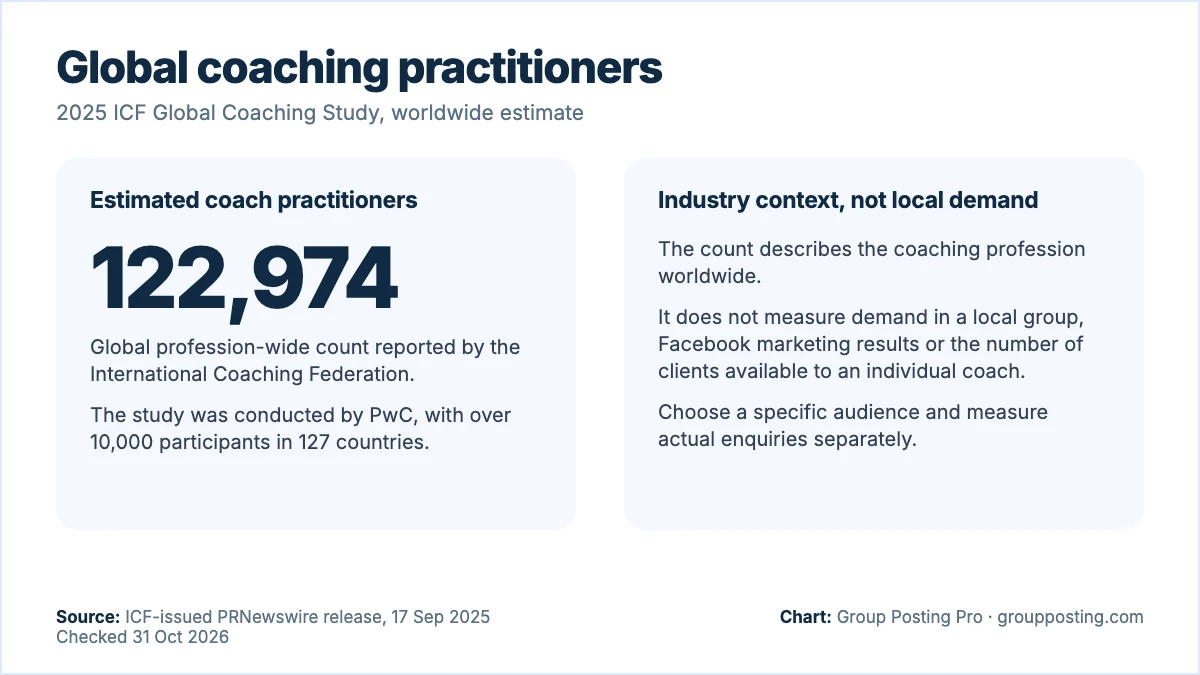
- The global practitioner estimate remains the anchor: ICF’s September 2025 study announcement reports 122,974 coach practitioners worldwide. It is an estimate of practitioners, rather than ICF membership or potential clients.
- The study has international coverage: the same ICF-issued announcement says PwC’s survey engaged more than 10,000 participants in 127 countries. The participant pool is broader than coach practitioners alone; its size does not make it a local customer survey.
- Credentials matter to how coaches describe expectations: ICF France’s discussion of the 2025 study says 73% of coaches believe clients expect certification or credentials. This describes coaches’ perceptions, not a finding from interviewing those clients.
- Coaching can sit alongside another service: ICF’s September 2025 announcement says 60% also offer training. The services overlap, so their reported shares should not be added together.
Apply this context by naming the service in the post, describing credentials accurately and stating whether an invitation concerns coaching, training or another activity. Keep the claims and professional boundaries below in place for every format.
1. Read the market context carefully
The International Coaching Federation’s 2025 Global Coaching Study announcement, issued by ICF on 17 September 2025, reported an estimated 122,974 coach practitioners worldwide. This is industry context, not a count of Facebook users, people seeking coaching or prospective clients in your area.
A worldwide practitioner count describes the profession’s scale. It does not tell you how many people in a particular Facebook group need your service, what they can spend or whether they want a conversation. Use local discussion and voluntary enquiries to assess those questions.
Choose a narrow offer from your actual competence instead of copying the most visible coaching category. An audience can be specific without implying that every person in it has the same problem. Read how members describe their own decisions before choosing your contribution.
2. Match audience, problem and competence
Write three lines before selecting groups: who you work with, the decision or development task you help them explore, and the service boundaries. Be precise about the kind of help you provide. Coaching language should not imply clinical treatment, therapy or regulated financial advice.
| Audience context | Useful contribution | Scope check | Permission to check |
|---|---|---|---|
| People considering a work-role change | A blank decision-criteria worksheet | Decision exploration, without promising a job | Provider advice and resources |
| New managers | A meeting-preparation reflection sheet | Management development within your competence | Business participation and links |
| Independent creative workers | A project-priority discussion prompt | Planning, without earnings predictions | Commercially connected discussion |
| Small business teams | A goals-and-review agenda | Coaching process, rather than legal or financial advice | Supplier contributions and discovery offers |
Inspect actual discussions and rules before adding a group to your working list. A coach-to-coach networking community serves a different purpose from a community for potential clients. Neither a large membership nor a familiar job title establishes that your proposed offer belongs.
Describe credentials exactly as held, including the issuing body where relevant. Do not turn course attendance into an accreditation claim or imply a professional endorsement you do not have. Keep the public explanation understandable to someone unfamiliar with coaching terminology.
3. Demonstrate a process without client stories
Show a blank decision worksheet instead of a success story. For a work-role choice, the fields might be options, criteria, unanswered questions and a next information-gathering step. Explain how to use the fields without deciding the person’s priorities for them.
Make one part usable in the post. For example, invite readers to write down the criteria they are using before comparing options. Label any completed sample as illustrative. Do not invent a client, imply that someone changed their life through the method or convert a coaching conversation into promotional material.
Use diagrams, blank worksheets or your own workspace objects as visuals. Keep names, consultation notes, messages and identifying circumstances out of the material. A story can be recognisable even after the person’s name is removed, so a fictional persona that appears to represent a real client is unnecessary here.
Decide what belongs in public. A general process question can be discussed in the group, while personal circumstances may need a separate appropriate setting. Do not ask someone to disclose sensitive details to receive a basic resource.
4. Keep claims and relationships clear
The U.S. FTC’s advertising guidance for small businesses says advertising must be truthful and supported by evidence before it runs. Both express and implied claims matter. Applied to a coaching post, that means an earnings implication needs support even when the sentence avoids an explicit promise; that application is our editorial reading of the guidance.
The FTC’s social media disclosure guidance explains that relevant financial, employment, personal or family connections should be disclosed with an endorsement itself. A disclosure does not turn an unsupported claim into a supported one.
For money-making opportunities, the FTC’s 26 October 2021 earnings-claims notice announcement describes false or misleading anticipated earnings and typical-profit representations as unlawful. Its notice distribution included business and investment coaching. That context should not be read as a statement that every coaching service falls under the Business Opportunity Rule.
The practical writing rule is simple: describe the service and process you can support. Explain who the work is for, what happens in a session and what remains the client’s decision. Avoid using an earnings target, job outcome or business growth figure as the reason someone should trust a generic post.
Identify a commercial connection when you recommend your own work or promote another provider through an arrangement. Put the explanation where the recommendation appears. Do not rely on readers to infer your role from a profile or a distant disclosure page.
5. Use a 14-day contribution plan
This is an illustrative preparation and contribution plan, not a client forecast or a requirement to publish on every date. Follow the destination’s rules and leave time to answer questions thoughtfully.
- Days 1–2: define the service. Write your audience, competence, session format and scope boundaries. Check the actual credentials and experience you plan to mention. Prepare a plain explanation of the discovery process.
- Days 3–4: inspect relevant groups. Read recent discussions, allowed identities, resource rules and promotional formats. Ask an admin if the proposed contribution is unclear. Exclude groups where your intended activity does not fit.
- Days 5–7: build one blank worksheet. Choose a task from the discussion and provide instructions that produce a usable output. Try it with clearly labelled illustrative inputs and remove unsupported outcome language.
- Days 8–10: contribute to a real question. Give a useful public answer where business participation is allowed. Explain your coaching role. Offer the worksheet only through a permitted route, without assuming that interest authorises a private pitch.
- Days 11–12: clarify the optional discovery step. Where promotion is permitted, explain what that conversation covers and how someone requests it. Keep resource access separate from a decision to explore coaching.
- Days 13–14: review fit and questions. Record useful discussions, voluntary enquiries, unsuitable requests and time spent. Improve the service explanation or resource based on what was actually unclear.
Keep a group note with the rules, audience context and last check date. Keep individual enquiry details separately and only as needed. Meta’s Pages, Groups and Events Policies require notice, explicit consent to information use and clarity that the business, rather than Meta, collects it.
6. Three coaching templates
These illustrative fill-in templates are not client accounts or quotations. Replace the brackets with checked details and use them only where the group permits the proposed post, provider reply or offer.
A useful process post
Illustrative template: “Comparing [type of decision]? Before choosing, list the options and the criteria that matter to you. Then note what you still need to find out. I work as a [accurate coaching role] with [audience]. This blank worksheet supports that reflection: [permitted route]. It does not decide the answer for you.”
Give readers the core steps in the post. The worksheet should remain useful without a discovery call or a promise that following it will produce a particular result.
A reply to a relevant question
Illustrative template: “For [stated situation], one useful starting question is [appropriate general reflection question]. I provide [coaching scope], so this is my professional perspective. You do not need to share private circumstances here. If you want the blank [resource], [permitted request or link].”
Use a genuine question within your competence, not a diagnosis or an assumption about what is wrong. Respect requests for peer experience when a provider contribution would not fit.
A discovery conversation invitation
Illustrative template: “I offer [coaching scope] for [audience]. A discovery conversation covers your general objective, the format of the work and whether the service fits. It lasts [actual duration] and involves [real conditions]. Request details through [permitted route]. There is no need to book coaching to use the worksheet.”
State the actual process and conditions. Do not describe a sales conversation as a full coaching session or imply that attending it establishes a likely personal or financial outcome.
7. Define the discovery conversation
Explain what happens before asking someone to commit time. Give the format, actual duration, purpose and what, if anything, they should prepare. State any conditions clearly. Someone should be able to distinguish an introductory fit discussion from the coaching service itself.
Ask only what you need to assess fit. If the request falls outside your competence or professional boundaries, say so and explain the appropriate next step without attempting to solve it in a public sales reply. Avoid collecting detailed personal histories as a condition of learning your service scope.
Agree whether and how to continue. A person may want only the resource, may need more information or may decide against coaching. Record the chosen next step and stop after a refusal. The outreach guide covers context and agreed follow-up.
8. Review suitable enquiries
Separate public contributions, resource requests, discovery enquiries, completed discussions and accepted coaching engagements. A keyword match is not a prospective client until the person’s actual request and fit support that interpretation. Do not count repeat messages as new people.
Lead Radar’s periodic keyword monitoring can help organise attention while Chrome is open and the computer is awake and online. Some posts may be missed. Keep human review in this plan and use your own competence, availability and permission checks before replying.
Review the questions behind unsuitable enquiries. Repeated scope confusion calls for a clearer description; repeated requests outside your competence call for a different contribution or audience. Use the group post writing guide to revise the draft and Facebook group marketing for the wider operating plan.
Frequently asked questions
Which Facebook groups should coaches consider?
Choose communities where your actual audience discusses decisions within your competence and business participation is permitted. Coach networking groups and potential-client communities have different purposes.
What can I post without using client stories?
Share a blank worksheet, a process diagram or a general reflection question. Label completed examples illustrative and keep identifying personal circumstances out of the material.
How should I describe my coaching credentials?
Use the qualification or credential you actually hold and identify its issuer where relevant. Avoid implying accreditation, expertise or endorsement beyond what you can substantiate.
What should a discovery invitation explain?
State its purpose, actual duration, format and conditions. Explain how it differs from coaching and let the person decide whether to continue.
Does the global practitioner count establish local demand?
No. Global practitioner counts describe the profession. Assess a local group through its actual discussions, permissions and voluntary enquiries rather than inferring buying intent from worldwide figures.
Sources
- ICF: 2025 Global Coaching Study announcement, 17 September 2025.
- FTC: advertising guidance for small businesses.
- FTC: social media disclosure guidance.
- FTC: earnings-claims notice announcement, 26 October 2021.
- Meta: Pages, Groups and Events Policies.
- Group Posting: Lead Radar.
- ICF France: Global Coaching Study 2025 de l’ICF, 2025 study discussion; checked 31 October 2026.
All sources checked 31 October 2026.
Part of Facebook groups for local businesses, by trade, our topic page with every guide on this subject. Start with the main guide: Free Local Business Advertising: Channels and a 30-Day Plan.
For the group-publishing part of your workflow, explore Lead Radar, or compare plans on Group Posting pricing.